Search is changing—and it’s changing fast. People no longer type fragmented keywords into a search bar. They ask full questions out loud and expect a direct, spoken answer.
AI assistants like Siri, Alexa, and Google Assistant are at the center of that shift. They interpret natural language queries, understand intent, and deliver responses. Not a list of links.
Businesses that understand conversational search optimization can structure their content to appear in those voice responses and AI-powered answers.
What Is Conversational Search Optimization?
It’s not about keywords anymore. It’s about questions.
Conversational search is how people interact with AI assistants and voice devices. Instead of typing “best burger place near me?” they ask, “Where can I find the best burgers near me?” That’s a natural language search query. It’s longer, more specific, and phrased as a real thought.
Conversational AI search goes beyond word matching. It reads intent. It figures out whether someone wants an answer, a recommendation, or a how-to, then surfaces the content that delivers it most directly.
Why Conversational Search Is Transforming SEO
Voice search is no longer a novelty. It’s how millions of people search every day, on phones, smart speakers, and AI chat interfaces. In the United States alone, 153.5 million individuals use voice assistants, with Siri being the most popular among them, attracting 86.5 million users.
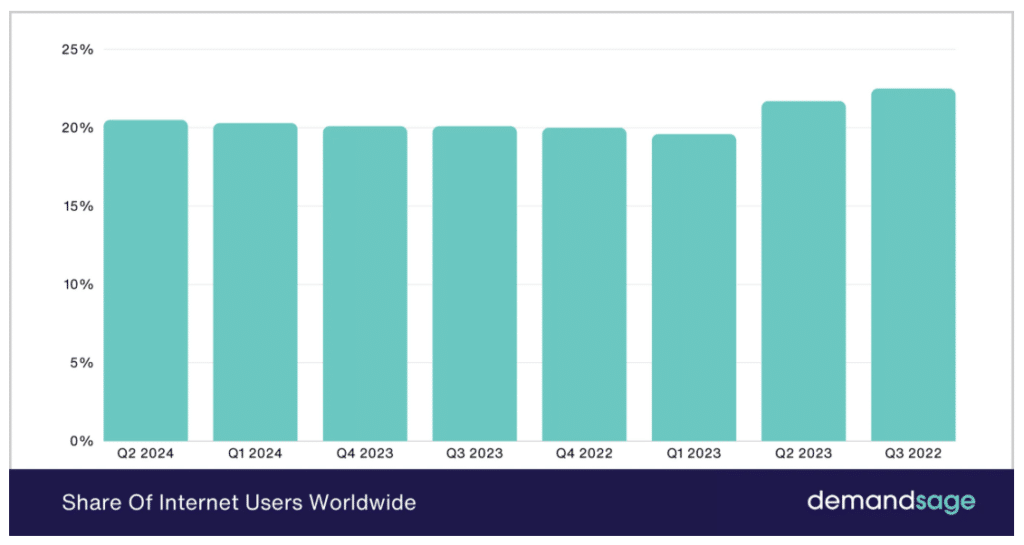
AI-driven search results have replaced traditional link lists in many scenarios. Ask a voice assistant a question, and it reads one answer aloud. That’s it. One source wins. That’s what makes voice search optimization so critical right now. Brands still writing only for desktop keyword searches are missing an entire channel.
AI answer engines like Perplexity, Google AI Overviews, and ChatGPT Search are accelerating this shift. Structured, trustworthy content now outperforms pages that are stuffed with keywords, consistently.
How AI Voice Assistants Choose Answers
Voice assistants don’t just pull the top-ranked page. They evaluate several signals to find the best answer.
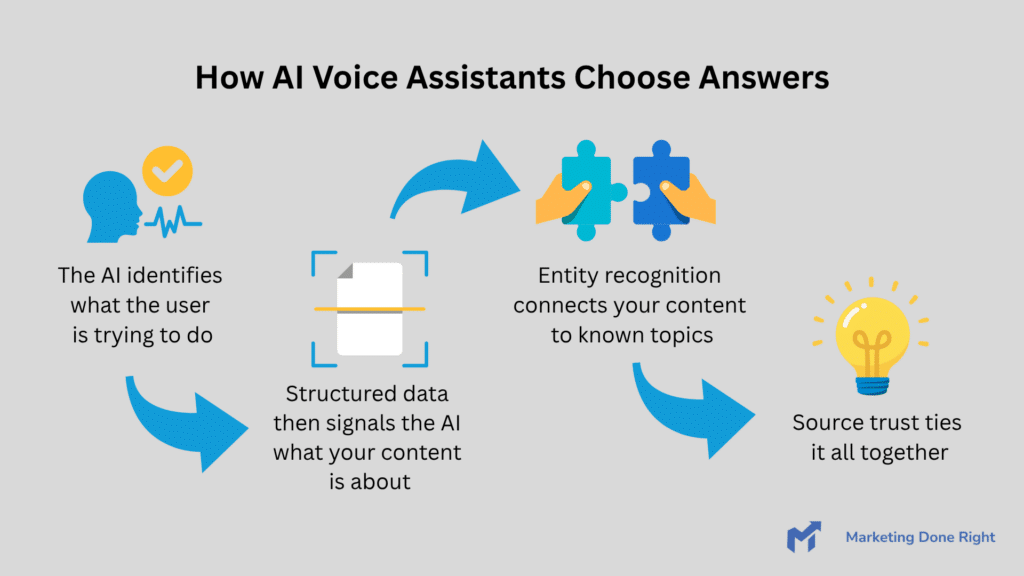
- Intent matching comes first. The AI identifies what the user is trying to do, whether that’s learning, finding, comparing, or acting, and looks for content that addresses that specific need.
- Structured data then signals the AI what your content is about in clear, machine-readable terms. Proper markup removes guesswork and makes your page easier to select.
- Entity recognition connects your content to known topics, brands, and places. The clearer those connections, the more confidently an AI will cite you.
- Source trust ties it all together. AI assistants prefer accurate, authoritative, well-linked content. Credibility isn’t optional. It’s the baseline.
5 Ways to Rank in AI Voice Results
Voice search prioritizes content that is clear, structured, and written the way people actually speak. These five strategies will help your content earn a place in AI voice responses.
Strategy #1: Write Content That Mirrors Natural Conversations
The most effective way to optimize content for conversational queries is to write the way your audience speaks.
- Use a natural, direct tone. Avoid heavy jargon that sounds more like a press release than a conversation. Write sentences that feel like something a knowledgeable person would actually say out loud.
- Incorporate long-tail question queries throughout your content. Phrases like “how do I,” “what is the best way to,” and “why does my” reflect how users phrase voice searches in real life.
- FAQ style formatting works especially well here. Breaking content into clear questions and answers gives AI assistants a structured, straightforward response format. Each question becomes a potential trigger for a voice search match.
Strategy #2: Use Structured Data and Schema Markup
Structured data for voice search is one of the most underused yet effective tools in SEO.
Schema markup for voice search tells AI systems exactly what your content contains. Without it, search engines have to guess. With it, you give them a clear, machine-readable map of your page.
Here are the most valuable schema types for conversational and voice search:
- FAQ Schema: marks up question-and-answer content so AI can extract direct answers
- How-To Schema: structures step-by-step content that voice assistants can read as instructions
- Article Schema: signals the topic, author, publish date, and content type of your page
- Entity relationships: connect your content to recognizable topics, brands, and categories that AI systems already understand
Investing in schema optimization gives your content a structural advantage. It removes ambiguity and makes your page a more reliable source for AI to cite.
Strategy #3: Focus on Question-Based Search Queries
Voice searches are almost always questions. Build your content around that reality.
- Target queries that start with who, what, where, when, why, and how. These are the exact phrasing patterns that trigger voice answers across all major AI assistants.
- Structure your headings as questions when possible. A heading like “How Do AI Assistants Select Voice Search Answers?” performs significantly better for voice search question formats than a generic heading like “AI Search Behavior.”
- Question-based content also earns featured snippets, the highlighted answers that appear at the top of standard search results. Featured snippets are the primary source that Google’s voice assistant reads aloud. Earning a snippet is often the same as earning the voice result.
- Answer the question directly and concisely. These targets featured snippets in the first two or three sentences following the heading.
Strategy #4: Optimize Content for AI Answer Engines
AI answer engines like Perplexity, Google AI Overviews, and ChatGPT Search scan your content for clear, extractable answers. Give them exactly that.
- Use clear, descriptive headings. This tells the AI what each section covers before it reads a single body sentence.
- Use structured lists for steps, options, and comparisons. Bullet points and numbered lists are easier for AI systems to parse and reproduce than dense paragraphs.
- Write concise answers at the top of each section. Lead with the answer, then expand with supporting detail. This inverted pyramid format matches how AI answer engines pull responses.
- Apply formats that are snippet-friendly throughout. Keep your answers under 50 words when possible. Use plain language. Avoid burying key information in long paragraphs.
The goal is to make your content feel like a trustworthy, well-organized reference. The kind of source an AI would confidently cite when answering a question.
Strategy #5: Improve Content Clarity and Authority
AI systems select the most credible and accurate answer available. Your content needs to demonstrate expertise, not just cover the topic.
- E-E-A-T signals (Experience, Expertise, Authoritativeness, and Trustworthiness) are the framework Google and other AI systems use to evaluate content quality. Pages that clearly show who wrote the content, what qualifies them, and why the information can be trusted perform significantly better in AI-driven search results.
- Expert authorship matters. Include clear author bios, link to credentials, and cite reputable sources throughout your content.
- Content depth also signals authority. Shallow articles that barely scratch the surface rarely get selected by AI assistants. Comprehensive, well-researched content that fully answers a question is far more likely to be cited.
This is where conversational search optimization intersects directly with content quality. The best performing content is not just formatted correctly. It is genuinely useful, accurate, and written by people who know the subject.
How Conversational Search Impacts Website Design
AI ranking in voice results isn’t just a content challenge. It’s a technical one too.
Mobile-first design is nonnegotiable. Most voice searches happen on mobile. A poor mobile experience sends negative signals to every AI and search engine evaluating your site.
Page speed determines whether your content gets crawled, indexed, and selected. Slow pages get passed over by users and AI systems alike.
Structured navigation helps AI crawlers map your site. Clear internal links, logical URLs, and descriptive anchor text all contribute to how easily your content gets cited.
Voice-friendly layout means short, digestible content blocks. What’s easy for humans to read is also easy for AI to parse.
Tracking Conversational Search and AI Visibility
AI citation tracking monitors when your content appears as a source in AI-generated answers across Perplexity, ChatGPT Search, and Google AI Overviews.
Voice search impressions can be partially tracked in Google Search Console by filtering for question-based queries and featured snippet positions.
Share of search monitoring shows how often your brand surfaces across all search channels, including AI, relative to competitors.
These metrics are still evolving. But the brands tracking them now will have a real head start as AI search continues to grow.
Common Mistakes That Prevent Content from Ranking in Voice Results
Most content doesn’t fail because of bad ideas. It fails because of avoidable execution errors.
- Overly complex sentences. Voice assistants read answers aloud. Tangled sentences don’t survive the translation.
- No structured data. Without schema markup, the AI guesses at your content’s meaning, and guessing rarely favors you.
- Keyword stuffing. Cramming in keywords at the expense of natural phrasing actively hurts your voice search performance.
- Weak content structure. Pages without clear headings and logical flow are hard for AI systems to parse and cite.
- No direct answers. If your content dances around the topic, an AI will simply find a source that doesn’t.
Clean, clear, and well-structured content is always the foundation.
Final Thoughts
AI search isn’t the future. It’s already here.
The brands showing up in voice results and AI-generated answers aren’t lucky; they’re prepared. Mastering conversational search optimization is how you get there. Adapt now, or get left out of the conversation.
Ready to rank in AI-powered search results? The team at Marketing Done Right can help you build a conversational SEO strategy that drives real visibility. Get in touch today and let’s get started.
Frequently Asked Questions
What is conversational search optimization?
Conversational search optimization involves structuring your website content to align with the natural, question-based language people use when interacting with AI assistants and voice search devices. It helps your content appear in voice responses and AI-generated answers.
How do voice assistants choose search results?
Voice assistants evaluate content based on intent matching, structured data signals, source authority, and how clearly the content answers the user’s question. Pages that provide direct, well-structured answers from trusted sources are most likely to be selected.
How can I optimize my website for voice search?
Start by writing in a natural, conversational tone. Use question-based headings, implement FAQ and How-To schema markup, keep answers concise and direct, and ensure your site loads quickly on mobile devices.
What role does schema markup play in conversational search?
Schema markup gives AI systems a machine-readable map of your content. It removes ambiguity about what your page covers, who authored it, and what questions it answers, making it significantly easier for AI assistants to cite your content.
Why are conversational queries important for SEO?
Conversational queries reflect how people actually search using voice and AI chat interfaces. As these channels grow, content that matches natural speech patterns will consistently outperform content written only for traditional keyword searches.
How does AI change search engine optimization?
AI shifts the focus from ranking for keywords to earning citations as a trusted source of answers. Success in AI-driven search depends on content clarity, structured data, demonstrated authority, and the ability to answer questions directly and accurately.