Ranking first on Google used to be the gold standard. With the rise of AI-powered summaries, marketers must now think about visibility in a world where content is seen but not necessarily clicked. One emerging tool that could help? LLMs.txt for AI SEO
LLMs.txt is poised to guide how AI models access and cite your web content. But is this just another SEO layer, or the beginning of a new era in AI visibility?
In this blog, we explore what LLMs.txt is, why it matters, and whether it represents the future of AI-driven SEO.
What Is LLMs.txt?
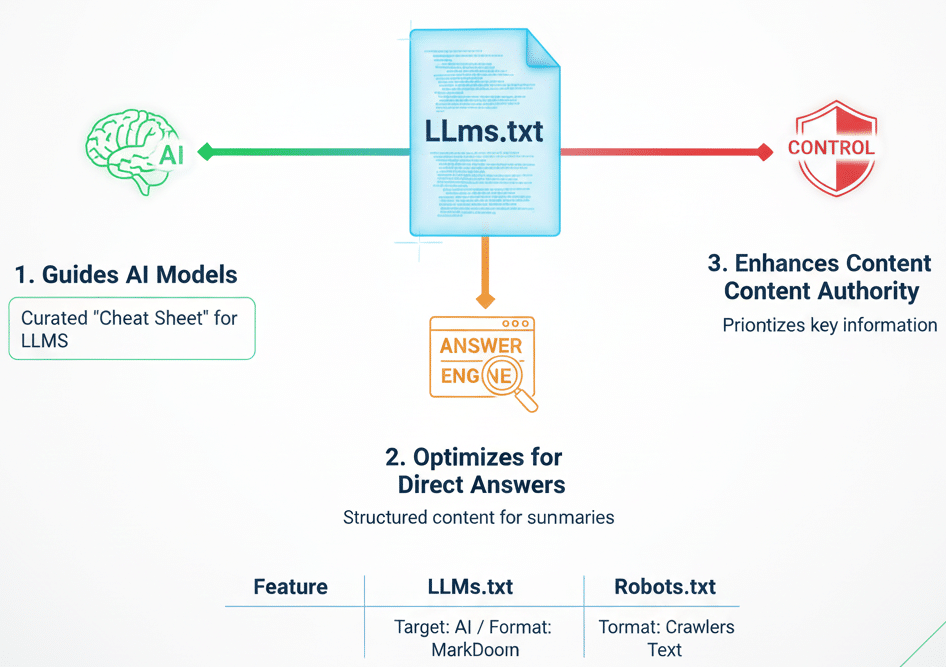
LLMs.txt is a proposed standard that allows website owners to control how large language models (LLMs) use their content. It’s a plain text file that signals which URLs on your site are high-quality and suitable for AI systems to ingest, understand, and potentially cite during content generation.
A typical LLMs.txt file can:
- Include a select, curated list of high-quality, AI-friendly URLs
- Specify preferred citation formats or source attribution rules
- Indicate how AI can summarize or use content (or not at all)
- Highlight expert-backed or frequently updated pages
This makes it a technical protocol with strategic value for AI search visibility.
Why LLMs.txt Matters for AI-Powered SEO
As generative AI tools begin shaping the search experience, marketers and publishers must rethink how content is accessed, cited, and surfaced. That’s where LLMs.txt for AI SEO becomes essential.
Key benefits of LLMs.txt:

- Prioritize authoritative content: By highlighting fact-checked, expert-authored resources, LLMs.txt ensures AI models pull from your most credible pages. This helps elevate accurate, brand-approved insights in generative responses.
- Guide AI toward expert-backed or timely sources: AI models often struggle to differentiate between outdated and current information. LLMs.txt can point them to recently updated resources, positioning your site as a go-to for trustworthy and fresh content.
- Provide citation preferences: You can offer guidelines on how content should be attributed—reducing the risk of misrepresentation or fragmented credit. This is especially important in regulated industries or for high-stakes content.
- Boost visibility even with low clicks: Citations in AI Overviews or chat results create ambient brand exposure. Even if users don’t click, consistent visibility builds recognition, trust, and top-of-mind awareness.
Unlike traditional SEO, which relies on ranking and click-through-rate, LLMs.txt can be a proactive way to shape AI-driven search experiences and influence how your brand is perceived, cited, and trusted within AI ecosystems.
How LLMs.txt Differs from Robots.txt and Sitemaps
While robots.txt controls how search engine crawlers access your site and sitemap.xml helps them index content, LLMs.txt serves a distinct role in the AI era: it informs LLMs how to interpret, reference, and cite your web content in generative outputs.
These files work in unison to manage how different automated systems interact with your website, from traditional crawlers to generative engines. Here’s a quick comparison of LLMs.txt vs robots.txt vs sitemap:
| Feature | Robots.txt | Sitemap.xml | LLMs.txt |
| Controls Crawl | Yes | No | No |
| Lists URLs | No | Yes | Yes (select, curated list) |
| Guides AI Use | No | No | Yes |
| Content Focus | Any/All | All Indexable URLs | High-quality, LLM-ready |
| Technical SEO | Foundational | Essential | Emerging advantage |
| Citation Control | No | No | Yes (intended) |
All three are files that live in your website’s root and communicate with bots. Still, they serve very distinct purposes: robots.txt is about restriction, sitemap.xml is about discovery, and llms.txt is about guidance and curation. Unlike other foundational tools, LLMs.txt is purpose-built for AI comprehension.
How LLMs.txt Impacts Marketing Strategy

Adding an LLMs.txt file is a signal that your brand is forward-thinking. Just as early sitemap adopters gained SEO advantages, those who embrace LLMs.txt could position themselves ahead in AI search visibility.
Direct AI Guidance
LLMs.txt empowers marketers to steer AI toward fact-checked, expert-written resources. This directly influences how your brand appears in AI summaries, helping you reduce misinformation and increase trust. It’s a strategic advantage in AI-powered search optimization.
Content Protection
It also acts as a safeguard against improper use of your content. By defining usage rights and preferred citation styles, LLMs.txt reduces the likelihood of misattribution, content distortion, or AI-generated hallucinations, thereby supporting your broader AI content governance strategy.
Brand Visibility
AI-generated results are rapidly replacing traditional blue links. Even when users don’t click, a presence in these results boosts brand awareness and credibility. LLMs.txt helps your brand earn visibility in high-trust digital spaces.
Is LLMs.txt the Future, or Just One More SEO File?

LLMs.txt won’t replace robots.txt or sitemaps. Instead, it adds a new layer of AI-specific control that complements traditional SEO fundamentals.
As AI continues to shape how content is retrieved and summarized, LLMs.txt gives marketers and developers a way to influence those first impressions, especially when optimizing content for LLMs
Should you consider adopting this in your marketing strategy? It depends on your priorities, but think about this: A recent SE Ranking analysis of 300,000 domains found that only 10.13% had an LLMs.txt file in place, meaning almost 9 out of 10 sites haven’t adopted it yet.
While LLMs.txt isn’t yet a universal standard, it’s still a high-potential best practice, especially for brands that want to shape how AI understands and cites their content.
FAQs: LLMs.txt and AI SEO
1. What does LLMs.txt actually do?
It’s a plain text file that instructs AI models which content to access, understand, and potentially cite. It enables website owners to curate AI-ready pages for enhanced AI comprehension and improved brand visibility.
2. Is LLMs.txt officially recognized by Google or OpenAI?
Not yet. While it’s gaining attention, major AI providers haven’t confirmed universal support—but early adoption can still show thought leadership.
3. Is LLMs.txt a replacement for robots.txt?
No. Robots.txt controls crawler access, while LLMs.txt guides AI on how to interpret and cite content. They complement each other.
4. Should I add an LLMs.txt file to my website now?
Yes, if you want to take a proactive approach to AI visibility. It’s a low-risk, potentially high-reward move for future-proof SEO.
5. Will LLMs.txt improve my search rankings?
Not directly. But it can increase AI-driven brand citations and help establish topical authority in future AI-powered experiences.
Final Thoughts
SEO is evolving. Visibility now depends on being understood and cited by AI models. LLMs.txt for AI SEO represents a new layer of visibility to shape your brand’s presence in generative search results.
At Marketing Done Right, we help brands navigate this changing terrain with strategies that prepare you for what’s next. Want to shape your AI presence before others catch up? Contact us today!