Most marketers know traditional SEO performance metrics, such as sessions, clicks, rankings, and conversions, like the back of their hands. However, while these KPIs remain useful, they were built for when search engines were the primary gateway to websites and content.
That isn’t the case nowadays. As 37% of consumers use generative AI for search, and AI citations, brand mentions, and zero-click searches become the norm, new metrics like share of search (SoS) are increasingly crucial.
Let’s talk about these current developments in AI-driven SEO performance tracking, why they matter, and how you can adapt your SEO dashboards accordingly.
Are Traditional SEO Metrics Like Sessions Still Enough?
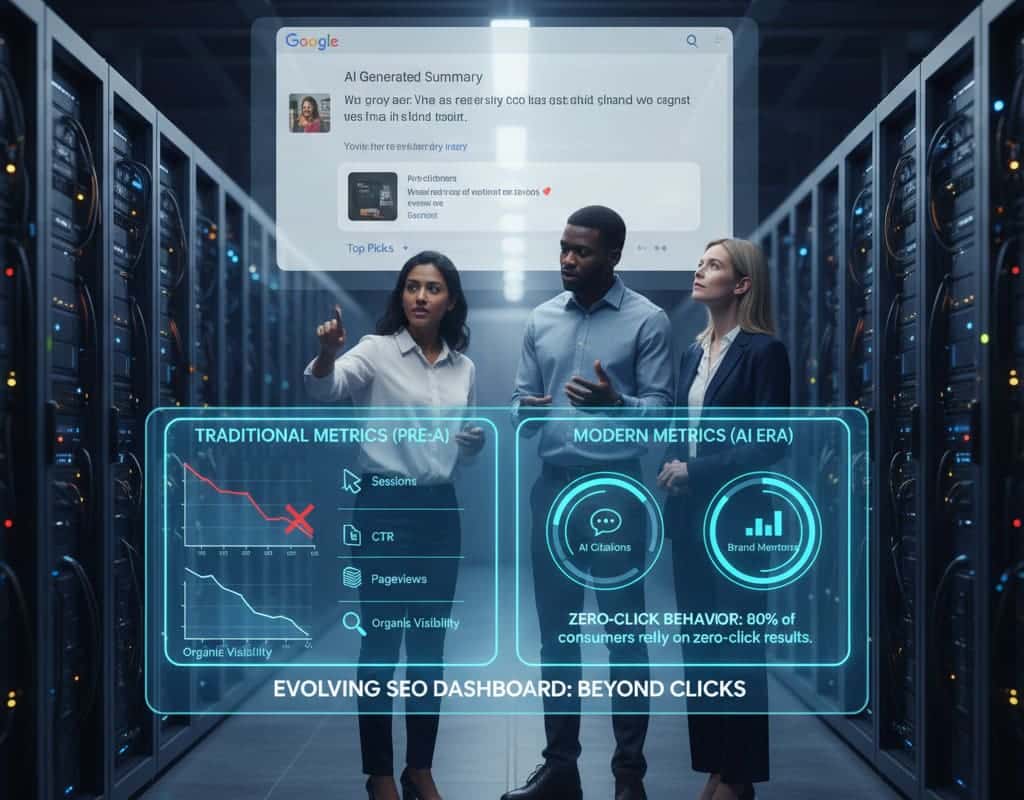
Before the prevalence of AI in search, marketers measured success via traffic-related KPIs, such as:
- Sessions
- Click-through rate (CTR)
- Pageviews
- Organic search visibility
These figures used to be the default indicators of site performance because they align with how search engines work: users search for something, click a result, and land on a website. Longer sessions, specifically, often led to a higher likelihood of conversion.
However, the rise of AI-powered discovery changed the game. Google’s search generative experience (SGE), for example, which displays AI-generated results on top of SERPs, means users can find information they need without ever entering a website.
This zero-click behavior means a brand can become visible and drive demand even without an increase in session metrics, especially with 80% of consumers relying on zero-click results in 40% of their searches.
Such unconventional behavior means it’s now essential to reassess your SEO dashboard beyond traditional tracking. Modern systems are now incorporating more specific brand visibility metrics that more accurately reflect how brands appear in AI-driven search, whether or not a click occurs.
Why Sessions Alone Don’t Tell the Full Story
AI assistants now play a fundamental role in identifying which products or brands are visible to users, often without requiring them to click on a website. It means that brand influence is determined way before a session ever occurs.
As mentioned, this shift is accelerating the growth of zero-click searches. Users are finding answers through Google’s SGEs, featured snippets, and other conversational interfaces that address their needs.
Furthermore, social media discussions, podcasts, video-sharing platforms, and forums are shaping awareness and trust outside of search engines. Such exposure can’t easily be captured by traditional, session-based SEO performance measurement.
These factors mean sessions alone offer an incomplete picture of your SEO performance. You could be experiencing a drop in traffic while gaining brand authority and visibility across AI and off-site platforms, or vice versa.
What Is Share of Search—and Why It Matters in 2026
SoS compares how often users search for your brand vs. your competitors. Unlike traditional SEO KPIs, SoS isn’t concerned with clicks or sessions. Instead, it focuses on the actual demand for your products or services, making it a reliable measurement of brand health.
Econometrician Les Binet helped bring this metric into the limelight, stating, “Movements in share of search often precede movements in market share.” In this sense, SoS acts as a leading indicator of consumer demand, visibility, and brand authority, rather than a lagging indicator like sessions or CTR.
Fortunately, tracking SoS is becoming increasingly accessible. For example, Google Trends allows you to compare search interest between brands. Modern SEO dashboards are also integrating SoS alongside traditional metrics for a more detailed picture of your performance.
AI Citations: The New Backlink?

Within AI-generated search results are AI citations. These are instances when SGEs and AI assistants explicitly reference a brand, product, or source.
Unlike traditional backlinks, AI citations don’t always link to a webpage. Still, they signal that AI systems recognize the referenced brand as relevant and authoritative. In fact, recent studies found that 54.5% of cited brands already rank highly organically in SERPs.
Tools like BrightEdge can help you track citations by offering answers to questions like:
- How often does AI reference your brand?
- In what prompts does your brand appear?
- How does your visibility compare to competitors?
Brand Mentions as Trust and Entity Signals
SEO used to place the highest value on linked mentions, such as in the case of backlinks. They helped search engines understand page relationships and authority. In contrast, unlinked mentions had a limited impact on SEO.
However, the same cannot be said with AI-driven search. AI systems and search engines are capable of identifying brands even when mentions are unlinked. In this case, consistent mentions of a brand across articles, social media, and other channels are what reinforce its credibility.
This shift aligns with entity-based SEO, in which search engines focus on understanding topics (e.g., people, products, organizations) rather than keywords. When a brand is frequently mentioned with a topic, AI systems are more likely to cite it.
To help you measure your brand performance in mentions, consider implementing these practices:
- Monitor linked and unlinked mentions across web content
- Analyze the context and sentiment of mentions
- Compare the volume, context, and quality of mentions with competitors
There are also tools specializing in brand monitoring and AI visibility tracking that can help you quantify these signals and integrate them into your SEO dashboard.
Frequently Asked Questions
1. Is share of search better than sessions for SEO reporting?
Yes, because share of search offers more accurate insights into demand, visibility, and brand authority. Session metrics aren’t enough in the AI-driven search environment.
2. How do I measure AI citations today?
Use analytics tools like BrightEdge and look for citation frequency, context, and competitor comparisons to measure your AI citations.
3. Do brand mentions influence rankings?
Yes. Consistent linked or unlinked mentions help reinforce credibility, encouraging AI systems to reference your brand.
4. Should sessions still be included in SEO dashboards?
Absolutely. Sessions are still valuable for understanding onsite user behavior, but they should be combined with other metrics, including SoS, to better understand performance.
5. How can I add these new KPIs to my reporting?
Integrate metrics such as SoS, AI citations, and brand mentions into your dashboard and track these trends over time while benchmarking against competitors.
Final Thoughts: Your SEO Metrics for 2026
Traditional SEO metrics are no longer enough. As AI dominates the search landscape, AI-driven visibility and KPIs, such as share of search, citations, and brand mentions, are becoming more important. So, be sure to integrate them into your SEO performance reporting to stay ahead.
Let Marketing Done Right help you out. Our SEO experts will help you track both traditional and AI-focused metrics to ensure you’re on the right track to reaching your marketing goals. Contact us today!